
Passetto di Borgo: The Secret Escape Tunnel of the Popes
Passetto di Borgo

The Vatican’s hidden lifeline
If you’ve ever watched the hit movie Angels & Demons, you’ve probably seen the Passetto di Borgo, the legendary elevated secret passage connecting Vatican City to Castel Sant’Angelo. But beyond the movie myth lies a brilliant piece of medieval military engineering with a history far more interesting than fiction.
That engineering was put to the test on a spring morning in 1527. An angry army of 20,000 soldiers invaded Rome and set the city on fire. Pope Clement VII woke up to find the Vatican under attack, and his only chance to survive was this narrow, 800-meter escape route hidden in plain sight. Acting like a medieval panic room, the high wall allowed the Pope to run safely above the violence into the fortress next door.
For years, public access to this secret path was restricted. Today, the famous passage is fully restored and open, letting modern travelers walk the exact escape route used by the popes.

The ultimate stronghold: Why Castel Sant’Angelo?
A secret tunnel is only useful if there is a safe place at the end. For the popes, that safe house was Castel Sant’Angelo. Originally completed in 139 AD as a grand tomb for the Roman Emperor Hadrian, this massive, round building was later transformed into a mighty military fortress. For roughly 600 years, the papacy used it as a fortress, a luxury palace, and a prison.
Timeline of a papal fortress
- 1277 | The birth of the lifeline: Pope Nicholas III officially claimed the castle for the papacy and constructed the Passetto di Borgo, linking the Apostolic Palace in the Vatican to the fortress. Its thick stone walls could endure heavy cannon fire, and the interior was stocked with deep-water wells, weapons, and enough grain to survive months-long enemy sieges.
- 1494 | The first test: The secret passage proved its worth when the notorious Pope Alexander VI (Borgia) successfully sprinted down the corridor to escape the invading French troops of King Charles VIII.
- 1527 | Luxury in hiding: During the height of the Renaissance, popes added lavish, beautifully frescoed papal apartments inside the fort. During the Sack of Rome, Pope Clement VII escaped through the passage and spent months living in these hidden rooms.
- 1870 | The end of an era: The papacy officially lost control of the fortress when Rome was integrated into the newly unified Kingdom of Italy.
- Castel Sant’Angelo Today: The fortress now operates entirely as a national museum. While the days of desperate popes fleeing down the secret tunnel are officially history, the fortress remains one of Rome’s legendary architectural landmarks.
Did you know?
Don’t get confused by the name – Passetto di Borgo has nothing to do with the infamous Borgia family. In Italian, it literally just translates to “The little passage of the neighborhood”. The word Borgo comes from an old Germanic word for a fortified town, which was used because pilgrims built a secure little village in that area long ago. Today, locals in Rome keep it even simpler and just call it “The Corridor” (Er Corridore de Borgo).


The architecture of deception
The Passetto di Borgo is a brilliant piece of hidden engineering, built from the ruins of ancient wars. Its story began all the way back in 547, when a Gothic king named Totila built a defensive wall for his army. Centuries later, around 852, Pope Leo IV rebuilt and strengthened these walls to protect the Vatican from outside threats.
But the cleverest part of the Passetto was added later, likely around 1277 by Pope Nicholas III, or during the 1300s by Pope Boniface IX. Within the thick stone wall, a hidden tunnel was built directly beneath the regular path where guards walked. To citizens on the streets below, it looked like an ordinary wall, but inside, it was a top-secret, two-level bridge built for survival.

How does it look inside?
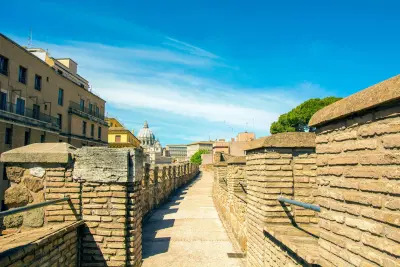
Stepping into the Passetto today reveals that this passageway was definitely not built for comfort and luxury. It is technically not an underground tunnel, but an elevated escape path stretching about 800 meters from the Vatican Palace to the fortress. Inside, you will see a long, arched space made of thick stone and medieval brick. The curved stone ceiling is a comfortable 240 cm high. This gave the Pope and his guards enough space to stand up straight and move quickly as they escaped.
While the ceiling is tall, the walking route is very tight. On average, the walkway is only 85 cm wide. In its widest sections, it opens up to 215 cm, and in its narrowest spots, it shrinks down to just 75 cm. The builders designed it this way on purpose to act as a choke point, trapping attackers and forcing them to pass through one at a time. Along the thick walls, builders put tiny, narrow slit windows. These small openings were designed so that running popes and their guards could look out at the crowded streets without being spotted by enemy archers below. Walking through this tight space today, you can easily feel how cramped and tense it must have been.
FUN FACT
The Passetto di Borgo tunnel was a two-way street. While popes ran away from the Vatican, high-profile prisoners were marched in the opposite direction. The papacy used the enclosed lower level to secretly transport dangerous criminals and high-profile prisoners from the Vatican to Castel Sant’Angelo dungeons.

Popes on the run: the first dramatic escape
The Passetto was more than a backup plan; it actively saved the lives of two popes on two different occasions.
The first dramatic escape happened in 1494, when King Charles VIII of France invaded Rome with 25,000 troops to depose Pope Alexander VI (the infamous Rodrigo Borgia). As French soldiers surrounded the Vatican, the Pope used the hidden tunnel to flee completely undetected. It worked perfectly, keeping him safe inside Castel Sant’Angelo while the two sides negotiated a peace treaty.

The bloodiest day: The Sack of Rome
The most famous use of the Passetto happened on May 6, 1527, during an attack on the city, known as the Sack of Rome. Months earlier, a legendary German commander, Georg von Frundsberg, had raised a massive mercenary force to fight for Holy Roman Emperor Charles V. The army of 20,000 mercenaries that attacked Rome was commanded by French nobleman and Imperial commander Charles III, the Duke of Bourbon.
The Duke, to inspire his troops, wore a bright white cloak so everyone could see him. However, this made him an easy target. Early in the battle, a shot rang out from the city defenses and killed the Duke instantly.

The sacrifice of the Swiss Guard
Instead of stopping the assault, the death of the Duke of Bourbon made the disaster far worse. With their commander gone, the Imperial soldiers lost all remaining discipline and headed directly toward the Vatican. Waiting for them on the steps of St. Peter’s Basilica were the Pope’s personal protectors, the elite Swiss Guard. Facing impossible odds, 147 out of 189 guards fought to the death against thousands of invaders. Their brave last stand bought the Pope the few precious minutes he needed to escape.
The remaining 42 guards surrounded the Pope and rushed him into the elevated stone corridor. Clement VII fled along the passageway to the fortified Castel Sant’Angelo for safety. To this day, the Vatican’s new Swiss Guards still swear their official oath of loyalty on May 6th to honor those fallen heroes.
Did you know?
Rumor has it that the notorious Pope Alexander VI frequently used the secret passage to sneak out of the Vatican to visit his mistresses. Over the centuries, this inspired a hilarious piece of local Roman folklore: locals joked that if a man walked the 800-meter length of the Passetto back and forth exactly 77 times, he would completely restore his lost virility.

How to walk the Passetto di Borgo
Thanks to a major 2025 Jubilee restoration, this once-rare summer exclusive is now permanently open to the public. Here is the simplest way to plan your visit:
- Mandatory booking: Because the corridor is a fragile historic site, access is limited to time slots and group sizes. You must book your combined ticket with Castel Sant’Angelo in advance.
- The route: The walk begins near the Vatican at the Torre del Mascherino. You will get to experience both the enclosed lower tunnel and the open-air upper walkway before finishing the route directly inside Castel Sant’Angelo.
PRO TIP
Step inside the Pope’s thrilling escape route and see for yourself what it felt like to flee. While the history inside the narrow tunnel is incredible, the best part of the tour is stepping outside onto the high walkway.
Because this path is raised high above the streets, it gives you a perfect view of St. Peter’s Dome and the massive Vatican walls. It is easily one of the best photo spots in the city, offering a stunning, peaceful view that makes the whole tour completely worth it.
Check out our Vatican Tickets and Tours to secure your spot!
Plan to visit the Vatican and walk the secret passage soon?
Make sure to check out our Vatican visiting guide first!

We have the best value Vatican tours & tickets for you!

LIKELY TO SELL OUT
Vatican Museum Tour
Take this tour and explore the ancient art collections with skip-the-line access. Walk through the Gallery of Maps, and visit the Raphael Rooms. Enter the Sistine Chapel and see Michelangelo's famous fresco "The Creation of Adam". Our expert guide will tell you many interesting facts you can't learn elsewhere!

City Pass
Vatican Pass
Are you looking for the best budget-friendly way to explore Vatican City? Then you should buy this Vatican City Pass! With this ticket, you will get skip-the-line access to key sites in Vatican City and Rome. This ticket includes access to the Vatican Museums and the Sistine Chapel.

skip the line ticket
Vatican Museum Ticket
With our Vatican Entry Ticket, you can easily access the Vatican Museums and the Sistine Chapel. Select your preferred time slot, and enjoy exploring the Vatican Museums and Sistine Chapel at your own pace. For a better experience, you can get an audio guide available in multiple languages.